NYCU and German Team Develop Light-Activated Nanopores for Smart Materials and Security Tech

2025-06-25

Imagine flipping a molecular switch using nothing but light. A groundbreaking study led by Professor Jiun-Tai Chen from the Department of Applied Chemistry at National Yang Ming Chiao Tung University (NYCU), in collaboration with Professor Patrick Théato from the Karlsruhe Institute of Technology (KIT) in Germany, has unveiled a novel class of “light-responsive nanopores.”

Titled “Illuminating Biomimetic Nanochannels: Unveiling Macroscopic Anticounterfeiting and Photoswitchable Ion Conductivity via Polymer Tailoring”, the research was published in the prestigious journal ACS Nano and opens exciting possibilities for future smart materials and anti-counterfeiting applications.

Nature-Inspired Innovation: Lessons from Algae

The inspiration came from an unlikely source: algae. In aquatic environments, algae navigate toward light to optimize photosynthesis, guided by light-sensitive ion channels known as channelrhodopsins (ChRs) embedded in their cell membranes. These channels enable algae to regulate ion flow based on light cues, maintaining physiological balance in changing environments.

Mimicking this natural mechanism, the research team engineered nanoporous structures from anodic aluminum oxide (AAO), then coated the pores with a light-responsive polymer made of spiropyran—a molecule that changes structure when exposed to light. The result: a synthetic nanopore system that can open or close in response to UV light, effectively functioning as a controllable ion gate.

A Light Switch at the Nanoscale
“The key lies in spiropyran’s molecular transformation,” explained Professor Chen. “When exposed to ultraviolet light, the molecule shifts from a closed, non-polar form to an open, charged form. This alters the nanopore’s hydrophilicity and drastically impacts ion transport.” Accompanying this transformation is a visible color change from clear to deep violet, hinting at applications in optical anti-counterfeiting labels where authentication could be done with the naked eye.
Toward a Sustainable Smart FutureBeyond security features, this light-gated nanopore technology holds promise for cutting-edge uses in drug delivery, optical data storage, and biomedical engineering. The findings mark a significant step forward in both materials science and biomimetic design.
In the near future, a single beam of light may be all it takes to unlock the full potential of smart materials—one photon at a time.

Source : NYCU News
News

5/14 Contemplative Approaches to Law, Governance, and Public Policy in Asia

In discussions on law, governance, and public policy, we often focus on institutions, rules, and problem-solving. But what if we also brought mindfulness, meditation, and contemplative approaches into these fields? Could they open up new ways of understanding and practicing law and governance? The School of Law, National Yang Ming

SDGs:
16
17
More

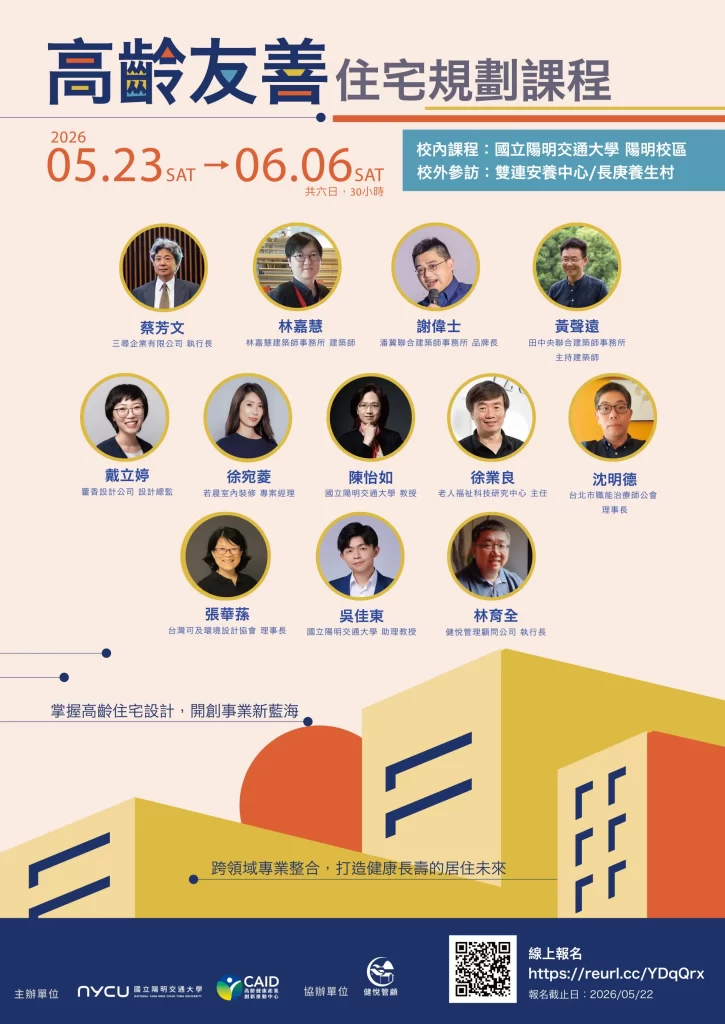
A Home That Grows Old Gracefully with You

Age-Friendly Housing & Training Program — Build the Essential Skills Needed for the Next Decade Have you ever wondered whether the home you live in today will still allow you to live comfortably, safely, and with dignity 30 years from now? As Taiwan enters the era of a super-aged society,

SDGs:
3
11
17
More

2026 NYCU Sustainability Year Official Launch – May Sustainability Action Month

The “2026 NYCU Sustainability Year” has officially begun! This year, National Yang Ming Chiao Tung University will launch a series of cross-campus, interdisciplinary, and issue-oriented initiatives. Through campus life, cultural engagement, environmental practices, and social inclusion, we invite the entire university community to rethink how sustainability can truly become part

SDGs:
1
2
3
4
5
6
7
8
9
10
11
12
13
14
15
16
17
More