As the global race for AI and semiconductor leadership accelerates, Taiwan is exporting more than advanced chips — it is also sharing its education model with the world.
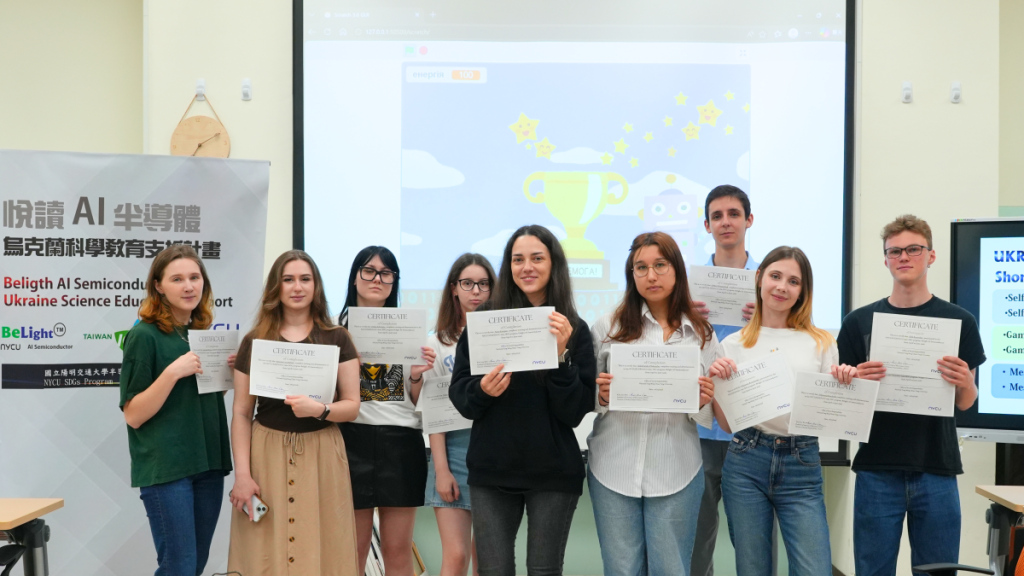
National Yang Ming Chiao Tung University (NYCU), in partnership with the Taiwan International Cooperation and Development Fund (TaiwanICDF), is bringing AI and semiconductor education to Ukrainian students in Taiwan through interactive learning, sensing technologies, and game-based teaching.
The initiative reflects a growing effort to transform Taiwan’s technological strengths into educational outreach and humanitarian support.
Turning Semiconductor Knowledge Into Everyday Learning
At the center of the program is “Belight AI Semiconductor,” an education initiative originally launched by NYCU and TSMC to make AI and semiconductor concepts accessible to younger generations.
Instead of treating semiconductors as abstract engineering knowledge, the program uses sensors, hands-on activities, and interactive storytelling to help students engage with technology in a more intuitive way. The project has since evolved beyond science outreach to a broader international education effort that combines AI applications, interactive learning, and cross-cultural exchange.
Ukrainian Students Encounter AI for the First Time
For many Ukrainian participants, the experience has fundamentally changed how they view AI and engineering.
“I came from a language and literature background, so technology always felt distant to me,” said Ukrainian student Kristina Lanoshchuk. “But after joining the program, I realized AI and semiconductors are actually much more approachable than I expected.”
Through interactive exercises and experimentation, students gradually learned the basics of AI sensing, semiconductor applications, and emerging technologies — often for the first time.
Beyond the classroom itself, many students said they were most surprised by Taiwan’s broader technology education environment. “In Ukraine, many people have never even learned what semiconductors are,” said another Ukrainian student, Mariia Leontieva. “But in Taiwan, children are already being introduced to these concepts at a very young age. That helped me understand why Taiwan became such an important global technology center.”
The students also observed that many Taiwanese university students already possess strong programming and engineering fundamentals — something they believe is connected to Taiwan’s long-term investment in science and technology education.
Learning Through Interaction Rather Than Memorization
The program incorporates AI sensing applications developed through the Rabboni platform, which promotes technology-driven education and social impact. Rather than relying on traditional lecture-based instruction, students learn through experimentation, interaction, and collaborative problem-solving.
“Technology education should not feel distant or intimidating,” said Kuei-Ann Wen, Executive Director of NYCU’s University Social Responsibility Office. “We hope students can experience AI and sensing technologies through exploration and creativity, while also seeing how technology can address real social challenges.”
From Taiwan’s Semiconductor Strength to Global Educational Impact
For NYCU, the initiative also represents a broader vision of how Taiwan’s semiconductor and AI expertise can contribute internationally beyond industrial production.
As AI reshapes education and society worldwide, the university sees technology education as more than workforce training. It is also a way to help younger generations build confidence, curiosity, and new ways of understanding the future. Through programs like “Belight AI Semiconductor,” Taiwan’s globally recognized technology ecosystem is being translated into something equally influential: educational impact.