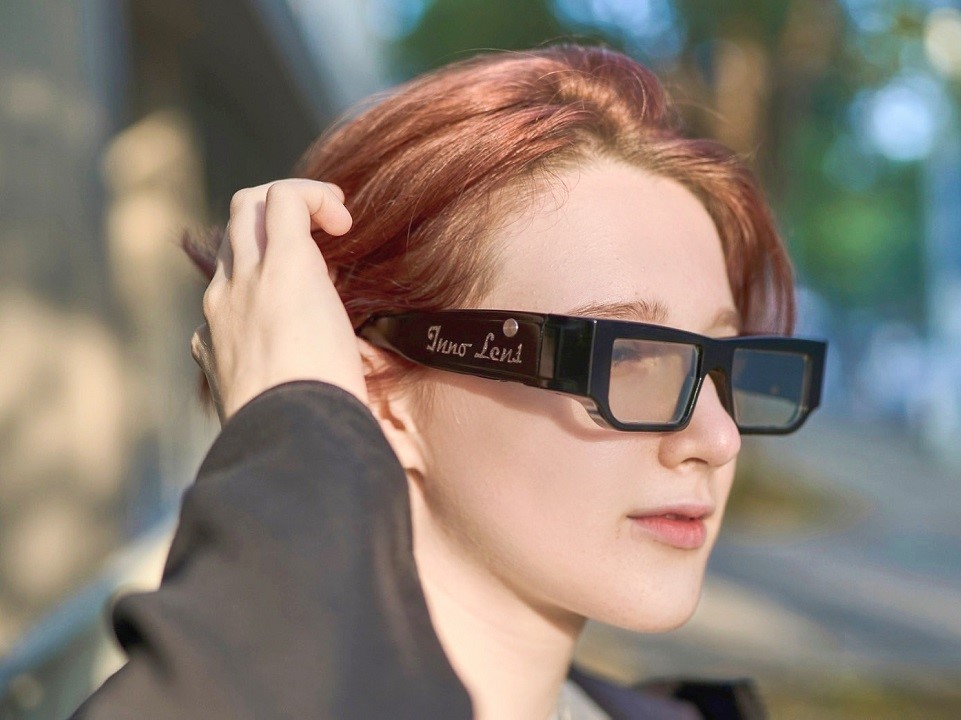
Two Centuries After Bifocals: NYCU Builds World’s First Electronically Adjustable Liquid Crystal Eyeglasses

2025-09-30

More than two centuries after Benjamin Franklin invented the bifocal lens, a research team at National Yang Ming Chiao Tung University (NYCU) has redefined how people with myopia and presbyopia see the world.
Led by Professor Yi-Hsin Lin of the Department of Photonics, the group has developed the world’s first battery-powered liquid-crystal eyeglasses with electronically adjustable optical power. This breakthrough promises to transform vision correction and extend to applications in augmented reality (AR), virtual reality (VR), and AI machine vision.
The findings were published in August 2025 in the journal Physical Review Applied and highlighted in a special feature by the American Physical Society, underscoring international recognition of Taiwan’s growing strength in liquid crystal optics.

A Major Leap Beyond Franklin’s Bifocals

Traditional bifocals allow users to switch between near and far vision, but only by tilting their heads or adjusting viewing angles. NYCU’s new design eliminates that limitation. The glasses feature gradient-index liquid crystal (LC) lenses whose refractive power can be finely tuned under an electric field generated by micro-electronics embedded in the frame. A simple touch on the temple arm instantly shifts focus between near and far objects.

“This concept has existed since the 1970s, but no one could make it practical for everyday eyewear,” said Professor Lin. “Fresnel-type LC lenses suffered from diffraction, chromatic aberration, and poor imaging quality. Our gradient-index design overcomes those barriers by enabling continuously adjustable focal lengths with minimal distortion.”
Global Collaboration and First-of-Its-Kind Results
The breakthrough was achieved with support from Taiwan’s National Science and Technology Council, Innolux Corporation, and Google Gift USA, in partnership with Kyiv University (Ukraine) and the University of Leeds (UK).

The team is the first to fully map the optical behavior of gradient-index LC lenses under electric fields, analyze switching speed and color distortion at different optical powers, and validate their feasibility for mass production. The result: a lightweight pair of eyeglasses that can electronically adjust prescription strength in real time, powered by a compact battery.

From Everyday Use to AR/VR
Beyond correcting myopia and presbyopia, the innovation opens new possibilities for wearable displays and machine vision systems, dramatically improving optical performance in AR/VR devices.

“This invention doesn’t just improve eyeglasses—it redefines the future of vision technology,” Lin said. “It shows the world what’s possible when physics, engineering, and global collaboration converge.”

News

2026 NYCU Sustainability Year Official Launch – May Sustainability Action Month

The “2026 NYCU Sustainability Year” has officially begun! This year, National Yang Ming Chiao Tung University will launch a series of cross-campus, interdisciplinary, and issue-oriented initiatives. Through campus life, cultural engagement, environmental practices, and social inclusion, we invite the entire university community to rethink how sustainability can truly become part

SDGs:
1
2
3
4
5
6
7
8
9
10
11
12
13
14
15
16
17
More

05/14 Love Can Also Be Harmful — The Truth Behind Animal Behavior!

Animal lovers across campus—gather up. We’re so proud of this one. In the 114-2 semester, NYCU Life Care Club is bringing a true heavyweight in animal behavior to campus: Dr. Geng-Ji Dai, a renowned expert in veterinary behavioral medicine. Talk title:   “Love Can Also Be Harmful — The Animal Behavior Truth You

SDGs:
15
More

05/14 (Thr.) Balcony Food Forest & Culinary Master Challenge

Life may be unpredictable—but great food is always worth savoring. Grow your own food forest on a city balcony, and prove your skills at the cooking station. The wildest feast, the most abundant table— the next top chef could be you!   In response to the 2026 NYCU  Living Festival, the

More